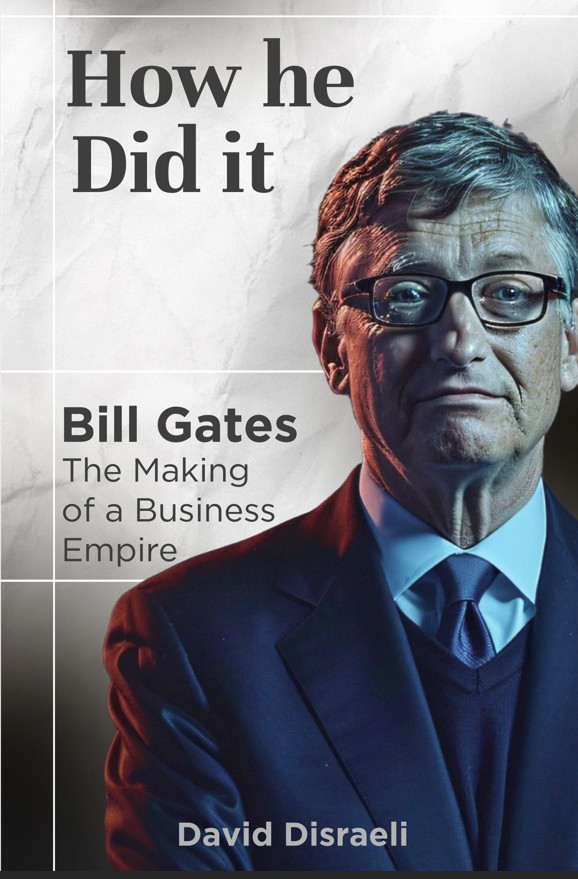
What This Book Actually Covers A Strategic Blueprint Drawn From Gates' Extraordinary Journey
Bill Gates is one of the most written-about figures in business history. Yet most of what has been written focuses on the mythology — the college dropout, the ruthless competitor, the reluctant philanthropist. What this book focuses on is more useful: the specific decisions, strategies, and principles that turned a 13-year-old with his first encounter on a school computer terminal into the architect of the defining technology company of the 20th century.
The book opens with the foundation Gates was building before anyone was paying attention. His curiosity was not casual — at 13, he was already spending every available hour programming at Lakeside School in Seattle. By the time he arrived at Harvard, he was not a student exploring possibilities. He was a founder waiting for the right moment. That moment came in 1975 when he and childhood friend Paul Allen read about the Altair 8800 microcomputer in Popular Electronics and recognized, before almost anyone else, that personal computing was about to become real.
From there the book moves through the decisions that built the empire: the licensing agreement with IBM that gave Microsoft its first platform dominance, the strategic purchase of QDOS — an existing operating system Gates adapted into MS-DOS rather than building from scratch — the development of Windows, the software licensing model that created a recurring revenue engine unlike anything the industry had seen, and the fierce competitive battles with Apple, IBM, and later Netscape that forced Microsoft to continuously innovate or die. Each chapter draws a principle from a specific moment in Gates' story and hands it to the reader as a tool.
Inside the Book 10 Chapters, One of History's Greatest Business Stories
Chapters 1–2 (Origins): Gates' childhood in Seattle was not typical. His family encouraged intellectual curiosity at every turn — his mother a prominent businesswoman, his father a successful attorney who modeled critical thinking and persistence. The book examines how that environment shaped not just Gates' technical skills but his worldview: that problems exist to be solved, that competition sharpens ideas, and that education is the foundation everything else is built on. His Harvard years are treated not as a detour but as the crucible where his entrepreneurial vision crystallized.
Chapters 3–4 (Building Microsoft): The Genesis of Microsoft chapter contains the book's most instructive financial moment. When IBM came to Microsoft for an operating system for its first personal computer, Gates did something that most observers missed entirely: instead of developing the OS from scratch, he purchased an existing product called QDOS for a reported $50,000, adapted it, and licensed it to IBM — while retaining the right to license it to other manufacturers. That single structural decision — owning the license rather than selling it outright — is why Microsoft became Microsoft and IBM did not own the PC era. This chapter is essential reading for anyone involved in licensing, IP, or entity formation.
Chapters 5–6 (Competition and Leadership): The competitive landscape chapters examine Gates' rivalries with Apple, IBM, and Netscape with unusual clarity. Rather than treating competition as conflict, Gates consistently treated rivals as information sources — benchmarks that revealed what Microsoft needed to improve. The leadership chapters examine his management style: demanding, data-driven, collaborative, and deeply focused on hiring people who were smarter than him in specific domains.
Chapters 7–10 (Legacy and Lessons): The philanthropic shift chapter is one of the more interesting in the series. Gates applied the same analytical rigor to the Bill & Melinda Gates Foundation — founded in 2000 — that he applied to building software. Measurable goals, data-driven allocation, willingness to pivot based on results. The book closes with 10 distilled principles every entrepreneur can apply immediately.
4 Key Takeaways What You'll Walk Away With
-
The Licensing Model Changed Everything
Gates' decision to license MS-DOS to IBM rather than sell it outright — and to retain the right to license it to other manufacturers — is one of the most consequential deal structures in business history. It created a recurring revenue engine and established Microsoft's dominance before IBM understood what it had agreed to. The lesson for entrepreneurs is structural: how you structure a deal matters as much as whether you close it. Ownership of IP and licensing rights are not legal details — they are the business model.
-
Vision Requires Specificity, Not Just Ambition
Gates' famous mission — "a computer on every desk and in every home" — was not a platitude. It was a precise operational target that told every employee exactly what they were building toward and why every product decision mattered. The book draws a sharp distinction between vague aspirational language and the kind of specific, measurable vision that actually drives organizational behavior. Entrepreneurs who want their teams to move with purpose need the latter.
-
Competition Is a Curriculum
Gates' rivalries with Apple, IBM, and Netscape are examined not as battles won or lost but as learning events. When Apple set a new standard for user interface design, Gates studied it and raised Microsoft's own standards. When Netscape emerged as the browser leader, Microsoft built Internet Explorer — not to destroy Netscape, but because Gates recognized the internet was the next platform and Microsoft had to own its layer of it. Treating competitors as teachers rather than threats is a discipline that produced some of Microsoft's most significant innovations.
-
Resilience Is Institutional, Not Just Personal
The antitrust battles Microsoft faced in the late 1990s — which consumed the company for years and threatened to break it up — are treated in the book as a case study in institutional resilience. Gates did not collapse under regulatory scrutiny. He used it as a forcing function to re-examine Microsoft's practices, engage more transparently with the industry, and emerge with a company that was structurally more durable. Building resilience into an organization's culture — not just its leadership — is one of Gates' most under-examined contributions.
Who Should Read This This Book Is Written For —
If you want to understand not just what Gates built but how he structured the deals and decisions that made it impossible for anyone else to own the PC era — this is the book that answers that question.
David Disraeli began his career as a stockbroker in 1986 and has spent four decades in financial services — advising clients on entity formation, licensing strategy, asset protection, and wealth preservation. He has formed 180+ business entities and protected 385+ properties across 11 states.
The Gates story is particularly resonant for David because so much of what made Microsoft dominant was structural — the QDOS licensing deal, the IBM agreement, the software licensing model. These are not just historical footnotes. They are the kinds of deal structures David has worked with throughout his career, and reading the Gates story through that lens reveals dimensions most business biographies miss entirely.
Get the Book Bill Gates: The Making of a Business Empire
Available on the Amazon Author Page · All titles in the How He Did It series