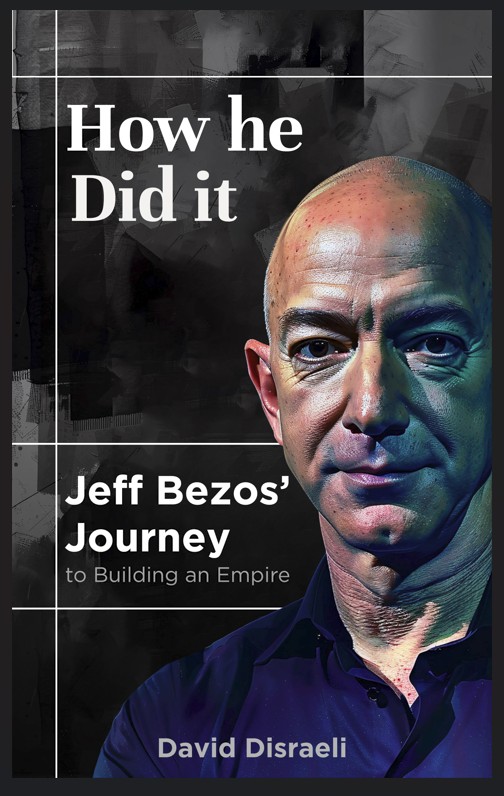
What This Book Actually Covers The Strategic Architecture Behind the World's Most Dominant Business Platform
Jeff Bezos is one of the most studied entrepreneurs in history — and yet most of what gets written about him focuses on the mythology: the garage startup, the customer obsession mantras, the relentless growth. What this book does differently is trace the specific decisions, structural moves, and strategic frameworks that turned an online bookstore into a company that simultaneously dominates retail, cloud computing, digital streaming, logistics, and devices.
The book opens where Bezos' story actually begins — not in a garage, but in a mind trained for pattern recognition. Growing up in Albuquerque, educated at Princeton in electrical engineering and computer science, and sharpened at D.E. Shaw on Wall Street, Bezos was not a dreamer who stumbled into e-commerce. He was an analyst who identified the internet as a once-in-a-generation inflection point and made a calculated bet at the exact right moment. His famous "regret minimization framework" — asking himself at age 80 which decision he'd regret more — is the kind of structured thinking that runs through every major Amazon decision that followed.
The book traces Amazon's evolution across 10 chapters: from the 1994 garage launch through the dot-com crash survival, the development of Amazon Prime, the creation of AWS, the Kindle, the fulfillment center buildout, and Bezos' philanthropic pivot. Each chapter isolates a principle from a real moment in the Amazon story and hands it to the reader as a tool.
Inside the Book 10 Chapters, One of History's Most Instructive Business Stories
Chapters 1–2 (Origins and Birth of Amazon): The early chapters establish the foundation that most Bezos biographies underweight: his pre-Amazon career. His time at Fitel, Bankers Trust, and D.E. Shaw gave him a Wall Street analyst's eye for structural opportunity. When he read that internet usage was growing at 2,300% annually, he didn't react emotionally — he ran a list of product categories and selected books because of their near-infinite SKU count, universal demand, and the impossibility of stocking them all in a physical store. That is not entrepreneurial intuition. That is systematic market analysis. It is the same discipline that would later produce AWS, Prime, and Kindle.
Chapters 3–4 (Growth and Customer Philosophy): The growth chapters contain the book's most important structural insight. Bezos' "customer obsession" was not a slogan — it was an operational discipline that explicitly deprioritized competitor monitoring in favor of customer signal. The Prime chapter is particularly instructive: what looked like a generous shipping subsidy was actually a flywheel designed to increase purchase frequency. Once customers paid the annual fee, they were psychologically incentivized to buy more from Amazon to justify the cost. Prime didn't just create loyalty — it restructured customer behavior at a fundamental level.
Chapters 5–7 (Leadership, Competition, and Technology): The leadership chapters examine Bezos' "working backwards" methodology — starting with a press release for a product that doesn't yet exist and building backward from the customer experience to the engineering. The competition chapters are notable for what Bezos didn't do: he consistently refused to be drawn into reactive competitive battles, instead focusing Amazon's energy on the customer problems competitors weren't solving. The technology chapters cover AWS in detail — a cloud computing business that emerged from Amazon's own internal infrastructure needs and became the most profitable division in the company.
Chapters 8–10 (Business Models, Philanthropy, and Legacy): The business model evolution chapters trace Amazon's shift from retailer to platform to infrastructure provider — three fundamentally different business models, each with different economics, running simultaneously. The book closes with Bezos' philanthropic work through the Bezos Day One Fund and the $10 billion Bezos Earth Fund, and the leadership lessons that run through the entire arc of his career.
4 Key Takeaways What You'll Walk Away With
-
The Flywheel Is a Business Structure, Not a Metaphor
Bezos' flywheel — lower prices attract customers, more customers attract sellers, more sellers expand selection, better selection lowers prices — was a literal design document for Amazon's business model. Every major Amazon initiative can be traced back to its effect on one or more flywheel components. Entrepreneurs who understand this can apply the same thinking to their own businesses: identify the self-reinforcing loops in your model and invest in the elements that spin them faster.
-
AWS Was an Accidental Empire Built on Internal Problem-Solving
Amazon Web Services did not start as a strategic initiative to enter cloud computing. It started because Amazon's own engineers needed standardized, reliable infrastructure and built it for themselves. Bezos recognized that what they'd built internally had external value and in 2006 launched it as a service. AWS now generates more operating profit than Amazon's entire retail business. The lesson: the infrastructure you build to solve your own problems may be your most valuable product.
-
Long-Term Thinking Is a Competitive Moat
Amazon operated at razor-thin margins — or at a loss — for years while Wall Street analysts questioned the business model. Bezos was not failing to generate profit; he was deliberately reinvesting every dollar into infrastructure, logistics, and new services. His famous shareholder letters consistently reframed quarterly losses as long-term investment. The willingness to absorb short-term pain that competitors couldn't or wouldn't absorb gave Amazon structural advantages that took a decade to fully materialize. That kind of patience is itself a strategy.
-
Customer Obsession Is an Organizational Design Choice
Most companies say they are customer-focused. Bezos built it into Amazon's operating system — literally. The "empty chair" he placed at leadership meetings to represent the customer, the mandatory six-page narrative memos instead of PowerPoint presentations, the "working backwards" press release methodology — these are not cultural gestures. They are mechanisms that force customer-centric thinking into every decision. Entrepreneurs can adopt these mechanisms directly.
Who Should Read This This Book Is Written For —
If you want to understand not just what Bezos built but how he structured the thinking, the incentives, and the organizational mechanisms that made Amazon's dominance self-reinforcing — this is the book that answers that question.
David Disraeli began his career as a stockbroker in 1986 and has spent four decades in financial services — advising clients on entity formation, asset protection, and wealth preservation. He has formed 180+ business entities and protected 385+ properties across 11 states.
The Bezos story is particularly instructive for David's clients because so much of what Amazon built — the flywheel model, the subscription revenue structure, the platform economics — maps directly onto questions entrepreneurs face at every scale. How do you design a business that compounds rather than grinds? Bezos answered that question more completely than almost anyone in history, and this book traces exactly how he did it.
Get the Book Jeff Bezos: Journey to Building an Empire
Available on the Amazon Author Page · All titles in the How He Did It series