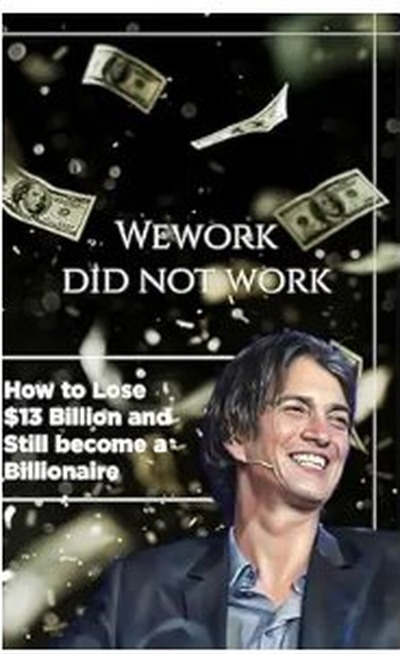
What This Book Actually Covers The Anatomy of a $47 Billion Valuation That Had No Business Existing
WeWork is one of the most studied business failures in recent memory — and still one of the most misunderstood. The popular narrative is that Adam Neumann was a charismatic fraud who fooled SoftBank and Wall Street. The real story is more instructive and more uncomfortable than that: WeWork was a real estate company that successfully convinced the investing world it was a technology company, collected $12.8 billion in venture capital on that basis, and built a business model structurally incapable of generating profit at scale.
The book opens with the number that frames everything: $12.8 billion raised. Then it asks the question every investor should have asked earlier — where did it go, and why didn't it produce a viable business? From seed round in 2010 to SoftBank's $10.65 billion commitment, the book traces the full funding timeline and the valuation inflation that accompanied each round. At its peak in early 2019, WeWork was valued at $47 billion. By October 2019 — six weeks after the IPO prospectus was released — the company had withdrawn the offering, the valuation had collapsed to under $10 billion, and Adam Neumann had been removed as CEO with a $1.7 billion exit package.
The book covers nine chapters across the full arc: the founding vision, the growth mechanics, the culture Neumann built, the business model's structural flaws, the governance failures, the IPO collapse, and the lessons for everyone who operates in a world where valuation and viability are treated as the same thing.
Inside the Book 9 Chapters Tracing the Complete Rise and Collapse
Chapters 1–2 (The Vision and The Rise): The opening chapters establish what WeWork actually was versus what it claimed to be. Neumann and co-founder Miguel McKelvey identified a real market need — flexible workspace for the gig economy — and built a genuinely appealing product. The co-working concept was sound. The problem was the layer of mythology stacked on top of it. WeWork didn't pitch itself as a commercial real estate operator offering short-term subleases. It pitched itself as a technology platform creating a global community. That reframing justified tech-company valuations for a business with real estate economics — long-term lease obligations against short-term membership revenue. The funding timeline chapter is particularly valuable: it shows exactly when SoftBank's Vision Fund became the dominant investor and how Masayoshi Son's $100 billion fund created pressure to deploy capital at scale regardless of whether the underlying businesses justified it.
Chapters 3–5 (Culture, Business Model, Leadership): The culture chapters are the most psychologically interesting. WeWork created a genuine community — events, workshops, networking, aesthetically designed spaces — that attracted real loyalty from members. The problem was that this community culture was also used internally to suppress financial skepticism. Employees who raised concerns about the business model were seen as failing to believe in the mission. The business model chapter breaks down the structural mismatch that made profitability nearly impossible: WeWork signed 15-year leases on premium real estate, then sublet that space on month-to-month memberships. In a downturn, lease obligations are fixed. Revenue evaporates. The leadership chapters examine Neumann's dual-class share structure — which gave him roughly 20 votes per share versus one vote for regular shareholders — and how that governance structure made it nearly impossible for the board to exercise meaningful oversight.
Chapters 6–7 (The Fall and Lessons): The IPO chapter is the pivot point of the book. When WeWork filed its S-1 prospectus in August 2019, it was the first time the general investing public could read the actual financials. What they found: $1.9 billion in losses in 2018 on $1.8 billion in revenue, $47 billion in long-term lease obligations, and governance provisions that gave Neumann almost unchecked control. Within weeks, the deal had collapsed. The lessons chapter draws five principles for entrepreneurs: vision must be grounded in achievable plans; financial transparency is not optional; leadership charisma is not a substitute for governance; partnerships must align with core mission; and adaptability is not the same as pivoting away from accountability.
Chapters 8–9 (The Future and Conclusion): The book closes by examining what the co-working industry actually looks like post-WeWork and post-pandemic. Hybrid work has validated the underlying market need — flexible workspace demand is real and growing. What WeWork got wrong was not the concept but the capital structure and governance. The conclusion frames WeWork's legacy honestly: it pioneered a genuine industry category, demonstrated that community-focused workspaces attract real demand, and then destroyed itself through financial recklessness and unchecked founder authority. Both parts of that legacy matter.
4 Key Takeaways What Every Entrepreneur and Investor Should Know
-
Raising Capital and Generating Profit Are Not the Same Thing
This is the book's central thesis and it cannot be stated plainly enough. WeWork raised $12.8 billion and never achieved profitability. The funding rounds weren't evidence of a working business — they were evidence of a compelling narrative delivered by a charismatic founder in an era of cheap capital. For entrepreneurs: venture capital is not validation. For investors: a high valuation is not a business model. The question is always the same — what is the path to sustainable cash flow, and is it achievable at the scale being funded?
-
The Business Model Has to Work at Scale, Not Just in the Pitch Deck
WeWork's unit economics were viable in individual locations under ideal occupancy conditions. They were not viable at the company level when you added up $47 billion in long-term lease obligations against month-to-month membership revenue. This is the scale problem that killed WeWork: the more locations they opened, the larger the fixed cost base, and the more vulnerable they became to any occupancy decline. Entrepreneurs must stress-test their business model at 10x current scale before accepting growth capital — because that's what the capital will be used to build.
-
Governance Is Not Bureaucracy — It's Protection
Neumann's dual-class share structure gave him effective veto power over major decisions. The board could not remove him without his cooperation. This is not unusual in Silicon Valley founder culture — but WeWork shows where it leads when there are no checks on founder behavior. By the time the board finally acted to remove Neumann in September 2019, the damage was already done. For founders: governance structures that protect you from accountability also protect you from being told you're wrong. That is not an advantage.
-
Culture Eats Strategy — But Only If the Culture Is Real
WeWork's community culture was genuine at small scale and performed at large scale. As the company grew from dozens of locations to hundreds, the authentic community feel that had attracted early members was replaced by corporate standardization. Members noticed. The same cultural mythology that had been an asset became a liability when it was clearly manufactured. For entrepreneurs building community-driven businesses: culture cannot be a marketing strategy. It has to be an operational commitment, and it gets harder to maintain — not easier — as you scale.
Who Should Read This This Book Is Essential For —
The WeWork story is still unfolding — the company filed for bankruptcy in 2023 and is restructuring again. But the core lessons were visible in the S-1 prospectus in August 2019. This book is the guide to reading those signals before they become headlines.
David Disraeli has spent 40 years in financial services advising clients on how to build, protect, and structure wealth — which means he has spent 40 years watching clients make decisions based on valuations, pitch decks, and other people's money. The WeWork story is a case study in what happens when narrative substitutes for fundamentals at scale.
David's practice focuses on the opposite of what WeWork represented: conservative entity structures, asset protection, and financial plans built on what you actually own and what it actually generates. The WeWork collapse is one of the clearest illustrations available of why those principles matter — and what the cost is when they're abandoned in pursuit of a headline valuation.
Get the Book WeWork: The $47 Billion Delusion
Available on the Amazon Author Page · All titles in the How He Did It series