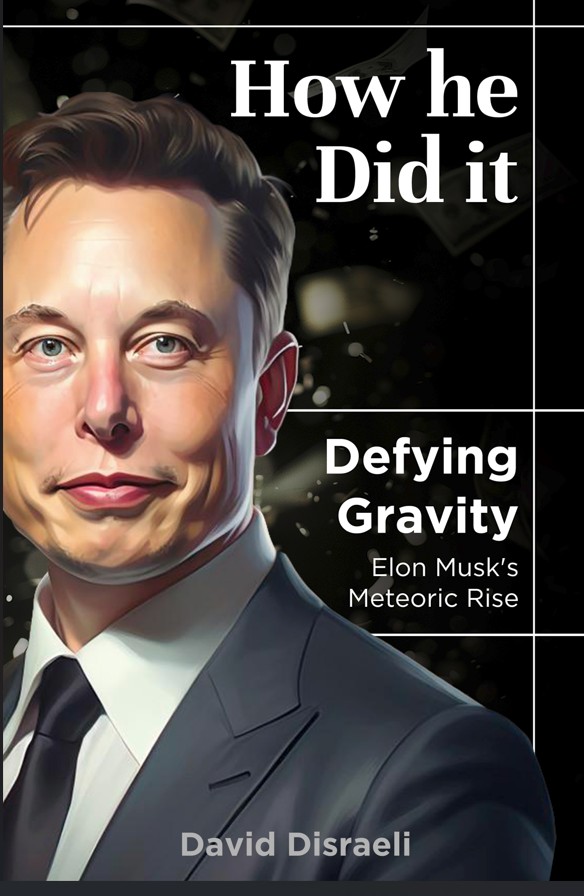
What This Book Actually Covers A Practical Playbook Drawn From Musk's Extraordinary Journey
Amazon's "Look Inside" gives you the chapter titles. What it doesn't convey is what makes this book different from the wall of Musk content already out there: this is a practitioner's framework, not a biography. Every chapter extracts a principle from Musk's real story and translates it into something an entrepreneur, business owner, or executive can apply starting today.
The book opens with the facts that matter most: Musk taught himself to code at 12, sold his first software for $500, and arrived in North America at 17 with a plan and a physics degree. His first company, Zip2, sold to Compaq for $307 million — earning Musk $22 million. Then came X.com, which merged into PayPal and sold to eBay for $1.5 billion, with Musk pocketing $180 million. What he chose to do with that money — pouring virtually all of it into SpaceX and Tesla simultaneously, with no fallback — is the central act of courage the book unpacks across 12 chapters.
From there, the book moves through the principles that produced the results: how Musk defines and communicates vision, how he distinguishes calculated risk from recklessness, how he builds teams that believe in an impossible mission, how he executes with agility, and how he maintains the discipline to ignore distraction when the stakes are highest. Each chapter uses specific moments from Musk's career to ground the principle — then hands it back to the reader as a tool.
Inside the Book 12 Principles, One Extraordinary Case Study
The book's 12 chapters are organized as a complete entrepreneurial framework — each one a principle drawn from a different phase of Musk's career:
Chapters 1–2 (Foundation): Vision and risk. How Musk defined a purpose that transcended profit — making humanity multiplanetary, transitioning the world to sustainable energy — and why that clarity of purpose gave him the resilience to absorb failures that would have stopped most founders cold. The book draws a sharp distinction between calculated risks, which Musk takes constantly, and reckless decisions, which he has also made and learned from.
Chapters 3–5 (Building): Innovation, team-building, and execution. Musk's approach to disruption isn't random — it targets industries where incumbent players have stopped innovating because they've stopped being afraid of competition. The team-building chapters examine how he hires for shared vision rather than credentials alone, and how the culture at Tesla and SpaceX reflects that philosophy in practice.
Chapters 6–8 (Operating): Technology, impact, and discipline. How Musk leverages emerging technologies before they're obvious to others, how he builds brands that carry emotional and social weight beyond the product, and — critically — how he maintains focus across multiple world-changing ventures simultaneously. His practice of scheduling days in five-minute blocks is examined not as a curiosity but as a system.
Chapters 9–12 (Sustaining): Networking, continuous learning, foresight, and legacy. The book closes by examining how Musk has built a support ecosystem of collaborators, investors, and advocates — and how the entrepreneurs who follow his example can do the same at any scale.
4 Key Takeaways What You'll Walk Away With
-
Vision Is an Operating System, Not a Slogan
Musk's goals — colonize Mars, electrify transportation, connect the planet via satellite — function as decision filters. Every hire, every investment, every product delay gets evaluated against the mission. The book shows entrepreneurs how to build their own vision with that same functional clarity, and why a vague mission statement produces vague results.
-
Failure Is Data, Not Defeat
SpaceX's first three rocket launches failed. Tesla came within days of bankruptcy in 2008. The book examines how Musk treated each failure as an engineering problem to be solved rather than a verdict on the venture — and how cultivating that mindset within a team creates an organization capable of iterating faster than competitors who are afraid to fail.
-
The All-In Moment Is Often the Turning Point
When Musk committed his entire PayPal proceeds to SpaceX and Tesla rather than diversifying, he created conditions that forced both companies to become excellent or die. The book examines the psychology and strategy behind that kind of commitment, and when it's a rational move versus a reckless one — a distinction that matters enormously for anyone building a business.
-
Disruption Requires Owning the Problem, Not Improving the Solution
Every Musk venture targets a root problem — fossil fuels, expensive space access, traffic congestion, AI risk — rather than incrementally improving what already exists. The book gives entrepreneurs a framework for finding those root problems in their own industries, where the real leverage is always hiding.
Who Should Read This This Book Is Written For —
If you've consumed every Musk documentary and interview and still want a structured, applicable framework for how his principles translate into your own business — this is the book that makes that connection.
David Disraeli began his career as a stockbroker in 1986 and has spent four decades advising clients on entity formation, asset protection, and wealth preservation strategies. He has formed 180+ business entities, protected 385+ properties, and represented himself in federal courts across multiple circuits — including a petition to the U.S. Supreme Court.
What makes the How He Did It series different from most business biographies is simple: the author reads financial structures the way most people read narrative. The deals, the term sheets, the compensation packages, the entity decisions — these are the vocabulary David works in every day. That lens is what this series brings to stories that have been told many times, but rarely told this way.
Get the Book Available Now on Amazon Kindle
Also available on the Amazon Author Page · All titles in the How He Did It series