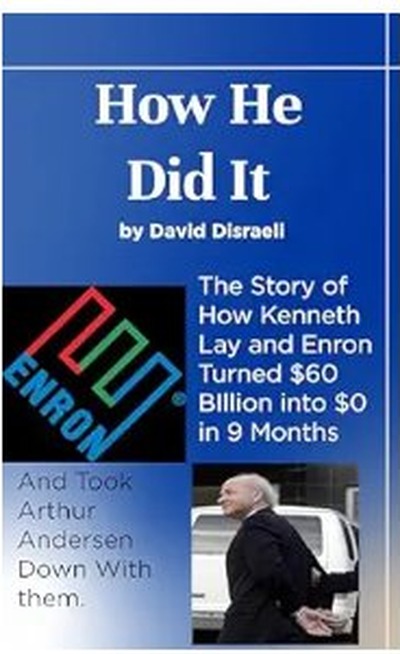
What This Book Actually Covers How the Most Admired Company in America Became Its Most Notorious Fraud
The title Gravity Wins is a statement of physics, not metaphor. You can suspend something in the air with enough energy — hot air, hype, accounting tricks, a compliant auditor, a deferential board, and Wall Street analysts who were incentivized to say yes. But eventually, gravity wins. It always does. The Enron story is the most complete demonstration of that principle in the history of American corporate life.
At its peak, Enron was not just a successful company — it was a celebrated one. Fortune named it "America's Most Innovative Company" six years in a row. Jeff Skilling was lauded as a visionary. Kenneth Lay had the ear of presidents. The stock hit $90 per share. Then, over the course of roughly 12 months in 2001, it all came apart. By December 2001, Enron had filed for what was then the largest bankruptcy in US history. By early 2002, Enron's auditor — Arthur Andersen, one of the "Big Five" accounting firms — had been indicted and was dissolving. Congress passed Sarbanes-Oxley, the most sweeping overhaul of corporate governance since the 1930s. And 20,000 employees had lost their jobs, often along with retirement savings that had been heavily concentrated in Enron stock.
This book traces the complete arc across 10 chapters: the founding vision, the innovations in energy trading that were genuinely real, the governance failures that allowed those innovations to curdle into fraud, the specific financial mechanisms — mark-to-market accounting, Special Purpose Entities — that hid the rot, the warning signs that were visible and ignored, the collapse itself, and the legal and regulatory aftermath that reshaped American corporate law.
Inside the Book 10 Chapters Tracing the Complete Anatomy of Corporate Collapse
Chapters 1–2 (The Rise and Governance Structure): The opening chapters establish something important: Enron was not fraudulent from the beginning. Kenneth Lay's founding vision — transforming a natural gas pipeline company into a market-maker for energy commodities, leveraging deregulation as a competitive advantage — was genuinely innovative. The electronic trading platform Enron built was real and functional. The energy derivatives it created were sophisticated and, in their original form, legitimate. Understanding what was real about Enron is essential to understanding how the fraud became possible: it was built on a foundation of genuine achievement that created an aura of credibility regulators and investors were reluctant to pierce. Chapter 2 examines the governance structure that enabled abuse — a board closely tied to Lay personally, an audit committee that lacked the expertise or independence to challenge management, and a compensation structure that created massive incentives for short-term financial manipulation.
Chapter 3 (The Financial Maneuvering): The technical center of the book. Two mechanisms above all made Enron's fraud possible. The first is mark-to-market accounting: Enron was permitted to record the estimated present value of future profits on energy contracts the moment a deal was signed — not when the cash arrived. This allowed the company to book billions in "earnings" that existed only as projections, creating a permanent gap between reported profits and actual cash flow. The second mechanism is Special Purpose Entities (SPEs): Enron created hundreds of off-balance-sheet vehicles — nominally independent companies — to which it transferred debt, hiding liabilities from its consolidated financial statements. Both practices were technically legal at the time; what made them fraudulent was the deliberate intent to deceive and the sheer scale of the distortion they created. The chapter explains how these mechanisms worked in plain terms, with direct implications for anyone reading a financial statement today.
Chapters 4–5 (Kenneth Lay and the Warning Signs): The leadership chapter is the book's most psychologically probing. Lay was not simply a criminal — he was a genuinely charismatic leader who created a cult of personality that functioned as a governance-suppression mechanism. When employees believed they were part of a transformative enterprise, they were psychologically invested in not seeing the warning signs. The chapter on whistleblowers is particularly striking: Sherron Watkins, a vice president at Enron, sent Lay a detailed memo in August 2001 warning that "Enron could implode in a wave of accounting scandals." Lay's response was to have his lawyers investigate whether Watkins could be fired. The pattern — warnings raised, warnings ignored, messenger threatened — was consistent throughout Enron's final years.
Chapters 6–7 (The Collapse and Its Human Cost): The collapse chapter traces the sequence: dot-com bust reduces Enron's trading revenues, analyst skepticism finally surfaces publicly, credit ratings are downgraded, SPEs unravel as their value depends on Enron's stock price, a merger with Dynegy falls apart at the last moment, and on December 2, 2001, Enron files Chapter 11. The human cost chapter quantifies what this meant: stock that had been worth $83 a share in January 2001 was worth 26 cents by November. Employees who had been encouraged to hold their 401(k) savings in company stock — and were often locked out of selling during the critical period of decline — lost everything. The accounts are not abstractions. They are people who retired to nothing.
Chapters 8–10 (Legal Consequences, Lessons, and Legacy): The legal chapter covers the criminal charges against Lay and Skilling (Lay was convicted but died before sentencing; Skilling served 12 years), and the indictment and destruction of Arthur Andersen for obstruction of justice. The governance lessons chapter distills five principles that should govern any organization. The legacy chapter examines Sarbanes-Oxley directly — what it changed, what it didn't, and why the structural conditions that enabled Enron remain present in today's markets.
4 Key Takeaways What Every Executive, Investor, and Business Owner Must Understand
-
If Earnings Don't Track Cash Flow, Something Is Wrong
Enron's mark-to-market accounting allowed it to report soaring profits while generating little actual cash. This divergence — high reported earnings, low operating cash flow — is one of the most reliable red flags in financial analysis, and it was visible in Enron's filings for years before the collapse. For anyone reading a financial statement, operating cash flow is the number that doesn't lie. When reported earnings consistently outpace cash generation, the question of where those "earnings" actually are becomes critical. In Enron's case, the answer was: they didn't exist.
-
Off-Balance-Sheet Structures Are a Warning, Not a Feature
Enron created hundreds of Special Purpose Entities to move debt off its balance sheet — making the company look far stronger financially than it was. SPEs, variable interest entities, and other off-balance-sheet structures are not inherently fraudulent, but their use to conceal obligations from investors and creditors is. Sarbanes-Oxley and subsequent accounting reforms have tightened disclosure requirements, but off-balance-sheet complexity remains a consistent feature of financial fraud. The lesson: when a company's financial structure is significantly more complex than its business model requires, ask why.
-
An Auditor With a Consulting Contract Is Not an Auditor
Arthur Andersen earned more from Enron in consulting fees than in audit fees. This conflict of interest — the auditor financially dependent on the client it was supposed to scrutinize independently — was the structural precondition for the audit failure. Andersen was not uniquely corrupt; it was operating in an industry-wide culture where the lines between auditing and consulting had been deliberately blurred. Sarbanes-Oxley prohibited this arrangement for public companies. For anyone engaging external auditors or financial advisors: independence is not optional. An advisor who profits from your growth cannot objectively evaluate whether your growth is real.
-
Charismatic Leadership Without Independent Oversight Is an Existential Risk
Kenneth Lay's charisma was not incidental to Enron's fraud — it was a precondition for it. His ability to inspire loyalty, maintain investor confidence, and project institutional credibility created the social conditions under which the financial manipulation became possible. Boards that defer to charismatic founders rather than independently scrutinizing their decisions are not providing governance — they are providing cover. The single most important structural safeguard in any organization is a board or oversight structure that can say no to the person who built the company.
Who Should Read This This Book Is Essential For —
The Enron collapse happened over 20 years ago. Sarbanes-Oxley was supposed to prevent the next one. But the structural conditions that made Enron possible — governance captured by founders, auditors compromised by consulting relationships, analysts incentivized to say yes, investors seduced by consistent earnings growth — are all still present. This book explains the mechanisms clearly enough that you'll recognize them when you see them again.
David Disraeli has spent 40 years in financial services — passing the Series 7 and Series 24, earning the CFP® designation, and advising clients on entity formation, asset protection, and wealth preservation. The Enron story is not abstract to him. The accounting mechanisms that enabled the fraud — mark-to-market income recognition, off-balance-sheet entities, auditors serving dual roles — are structures he has evaluated in client situations throughout his career.
David has also served as an expert witness in FINRA securities arbitration, testifying on suitability and broker-dealer standards in cases involving investor losses. The question of what investors were told versus what was true — which is at the heart of the Enron story — is one he has worked with directly. This book draws on four decades of reading financial structures for what they actually say, not what they're designed to look like.
Get the Book Gravity Wins: The Rise and Fall of Enron
Available on the Amazon Author Page · All titles in the How He Did It series